


















Top 10 Forex Indicators
Forex indicators may seem complicated until you get a hold of them. The forex world is dynamic and fast-paced; traders rely on various trading tools to make informed decisions, and one of the most used features is the indicators. These best indicators for trading that help analyze price movements, identify trends, and provide potential entry and exit points. There are several types of indicators in forex with various purposes; traders should test and select the ones that are practical and match their trading strategy. This article will explore the most popular forex indicators, their applications, and how you can integrate them into your trading journey.
What Are Forex Indicators?
Forex Indicators are mathematical calculations based on historical price, volume, and market data. Traders use them to forecast price movements and determine when to enter or exit trades. There are different types of indicators; however, they are categorized into leading (predictive) and lagging (confirmation-based) indicators.
There are various types of indicators in forex with different functionalities, for example:
Volume Indicator assesses trading activities and liquidities.
Trend Indicators are the identifiers of the overall market direction.
Momentum Indicators are responsible for the measurement of the strength of price movements.
Volatility Indicators analyze market fluctuations at different periods.
Top 10 Forex Indicators
1- RSI
2- Fibonacci
4- MACD
5- Ichimoku Cloud
6- Bollinger Bands
7- Average True Range (ATR)
8- Stochastic oscillator
9- Standard deviation
10- Pivot Point
Let’s take a look at each of them in detail:
The RSI is a momentum oscillator that uses a scale from 0 to 100 to quantify the pace and change of price movements. A score below 30 indicates an oversold market, whilst a value above 70 sometimes indicates an overbought situation. For instance, if the EUR/USD ratio has an RSI of 82, traders may anticipate a possible reversal.
-
Fibonacci Retracement
Fibonacci retracement levels are used to identify potential reversal levels based on the golden ratio (23.6%, 38.2%, 50%, 61.8%, 78.6%). Traders plot it from a recent high to low or vice versa to predict support/resistance. For instance, after a bullish run in GBP/JPY, a pullback to the 61.8% level might present a buy opportunity.
Moving averages provide price information to determine the trend's direction. Simple Moving Average (SMA) and Exponential Moving Average (EMA) are the two most used varieties. The death cross and golden cross are common tactics. A bullish trend is indicated when a short-term MA (such as the 50-day) crosses over a long-term MA (such as the 200-day) (Golden Cross). A bearish trend is indicated when a short-term MA crosses below a long-term MA (Death Cross).
The MACD shows the relationship between two Exponential Moving Averages (12 and 26-day), with a signal line (9-day EMA). A bullish signal occurs when the MACD crosses above the signal line. If the MACD line crosses up during a pullback in USD/CHF, it might suggest a continuation.
The Ichimoku Kinko Hyo is a full trading system that shows support/resistance, momentum, and trend direction. Price above the cloud signals bullish conditions; below indicates bearishness. A break of USD/JPY above the cloud may suggest a strong upward trend.
-
Bollinger Bands
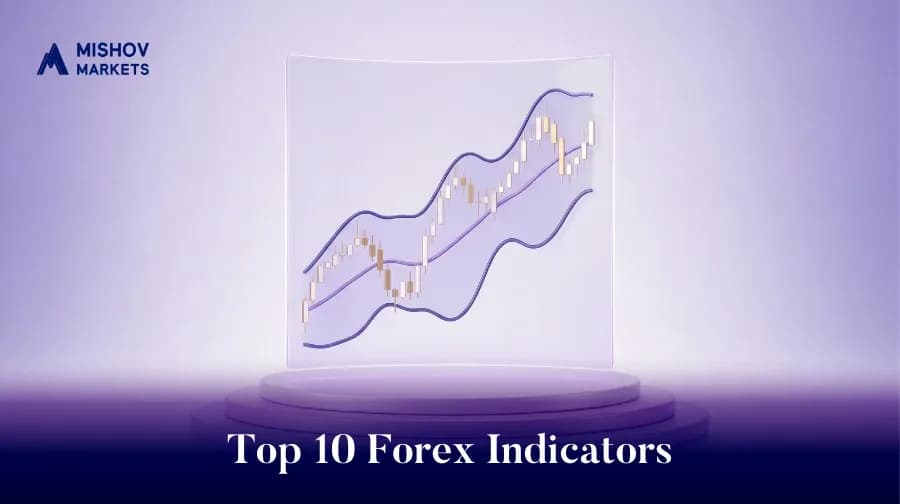
The Bollinger Bands consist of a middle Simple Moving Average and two outer bands placed two standard deviations apart. When the price touches the lower band, it may be considered oversold. A Bollinger squeeze, where the bands narrow, suggests a potential breakout.
-
Average True Range (ATR)
ATR measures volatility by calculating the average range between high and low prices over a set period. A rising ATR means increasing volatility. For example, during a news release affecting CAD, the ATR for CAD/JPY may spike.
-
Stochastic Oscillator
The Stochastic Oscillator indicator compares a particular closing price to its price range over a period. Readings over 80 indicate overbought conditions, while readings below 20 indicate oversold. If the Stochastic crosses below 80 on AUD/USD, it may signal a sell opportunity.
-
Standard Deviation
Standard deviation is a statistical measure of price volatility. A high deviation indicates large price moves, while a low deviation suggests consolidation. For example, when EUR/GBP has low deviation, a breakout may be imminent.
-
Pivot Points
Pivot points identify potential turning points using the high, low, and close from the previous day. Traders use them to find intraday support and resistance levels. For example, if the price bounces at the first support level (S1) on the DAX index, it may signal a buying opportunity.
Are Indicators Alone Enough?
Traders should know that often, indicators alone can provide inconsistent and inaccurate signals, which is why combining multiple best indicators for trading along with price action can create a more reliable trading strategy. A strong example involves using moving averages to confirm the overall trend, the RSI to identify overbought or oversold conditions, and the MACD to spot potential trend reversals and waiting for confirmation in price action.
A common pitfall is using too many indicators in forex at once, leading to what's known as "indicator overload", which can result in confusion and conflicting signals.
Additionally, traders often completely ignore fundamental analysis, such as economic news or central bank decisions, or rely too heavily on lagging indicators for quick trades. To avoid these mistakes, it's best to limit yourself to 2–3 well-tested indicators, integrate both technical and fundamental analysis into your decision-making process, and thoroughly backtest your strategy before using it in a live trading environment.